VCARSYSTEM Camera Video Injection Box Achieves Millisecond-Level Response
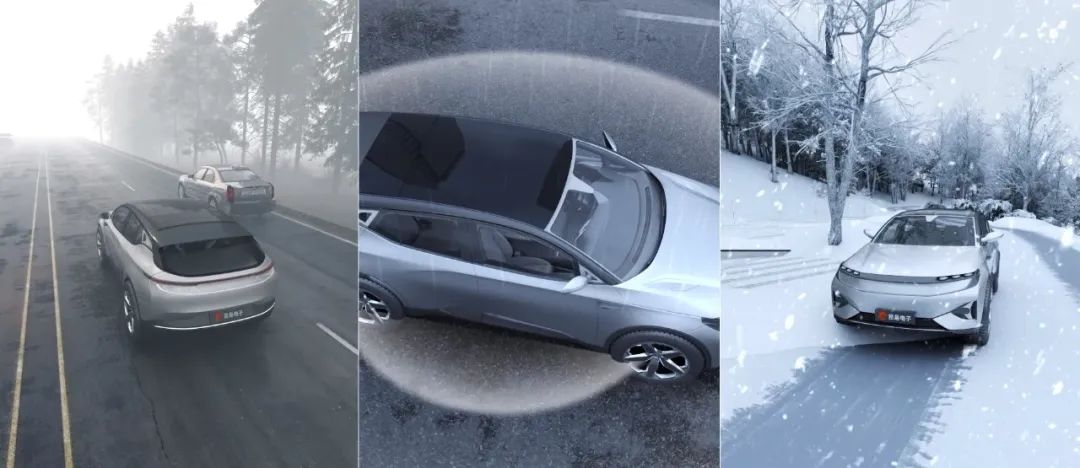
In the architecture of autonomous driving domain controllers, the camera, as the "visual nerve center" of environmental perception, uses its high-resolution optical imaging capability to accurately capture pixel-level details of lane lines, traffic signs, and other targets. It provides raw data for the domain controller, supports semantic segmentation and dynamic scene understanding, and serves as an irreplaceable input foundation for the decision-making and control layer. Meanwhile, more and more manufacturers prefer to combine camera data obtained from real-vehicle road testing with camera data simulated by scene simulation software for perception testing, in order to improve the controllability and coverage of testing.
However, under this testing scheme, the input of camera data still faces the following challenges:
1. Time synchronization errors between multiple cameras
When the timestamp deviation of multiple cameras is large, the fusion algorithm is prone to misjudging the target movement trajectory. For example, inconsistent sampling times of dynamic targets will lead to position calculation errors, affecting the accuracy of decision-making.
2. Fragmentation of interface protocols between the camera and the autonomous driving domain controller
There are various transmission protocols for cameras, such as GMSL, MIPI, and FPDlink. The complex models of serializers and CMOS Sensors from different manufacturers lead to great difficulties in hardware adaptation and poor compatibility.
3. Low coverage of fault scenarios in camera fault simulation testing
Traditional testing only relies on manual simulation of abnormal states such as camera frame loss, noise, and overexposure, making it difficult to comprehensively cover fault scenarios under complex working conditions. In long-tail scenarios such as extreme weather and sensor signal interference, key risk points are easily overlooked.
VCARSYSTEM Camera Video Injection Box
Developed for the core technical pain points of the industry, the VCARSYSTEM Camera Video Injection Box creates a high-precision and highly flexible video data stream injection solution based on real and virtual video data transmission technologies. The video injection box simulates camera output during testing and replaces real cameras to inject video signals into the domain controller, thereby improving testing efficiency and controllability without relying on physical cameras.
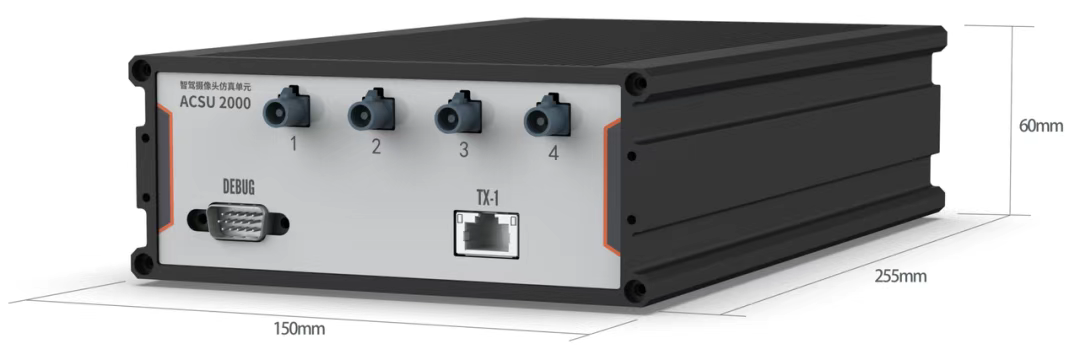
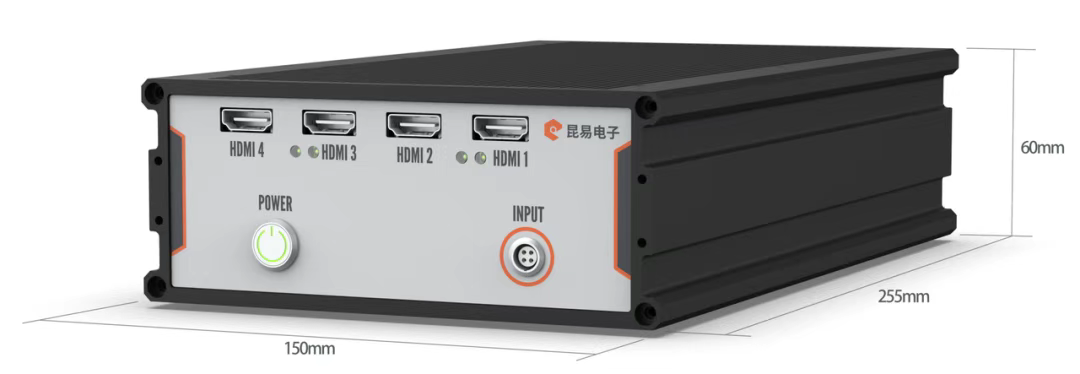
Millisecond-level synchronization accuracy to avoid perception result deviations
The time synchronization accuracy of each channel of the camera video injection box is ≤1ms, ensuring that the sampling moments of each camera's data are highly consistent. This enables the autonomous driving domain controller to output correct perception content during the perception phase, such as the surround view during automatic parking.
Rich adaptation experience for flexible conversion of multi-format data
Relying on abundant project adaptation experience, VCARSYSTEM can adapt according to the customer-defined I2C (Inter-Integrated Circuit) handshake protocol to ensure stable data interaction between the camera and the main control chip, achieving synchronous injection of multi-channel 4K@30Hz ultra-high-definition video.
Mainstream domain controllers already adapted:
Nvidia Orin, Xavier, Horizon J3/J5/J6, Black Sesame, TI TDA4, etc.
Cameras already adapted:
SERDES adaptation: Max9295/9295(A)/96793/96717/96717F/96715/96705/96701; TI 935/953CMOS Sensor adaptation: SONY, OV, On semi
In actual testing scenarios, due to differences in video access formats and domain control input requirements, the camera video injection box supports various input formats such as raw RAW/YUV, H264/H265 compression, RGB/JPEG, as well as YUV/RAW output formats. It flexibly adapts to various data format conversions, improving test data processing efficiency.
Real-time simulation of fault injection to accurately verify the stability of the intelligent driving system
Different from traditional manual simulation fault injection, which only covers camera image fault simulation, the camera video injection box can also simulate various common faults such as data transmission anomalies, image content anomalies, and camera hardware fault simulation. It supports real-time control of fault injection through the host computer and also supports continuous automated injection via command-line control.
Application Scenarios
Based on the camera video injection box, a full-cycle solution covering the R&D verification of intelligent driving algorithms to vehicle production line detection can be provided, helping the efficient connection between technical R&D and mass production.
Specific applications are as follows:
Scene Simulation Video Injection / Perception Verification Addition
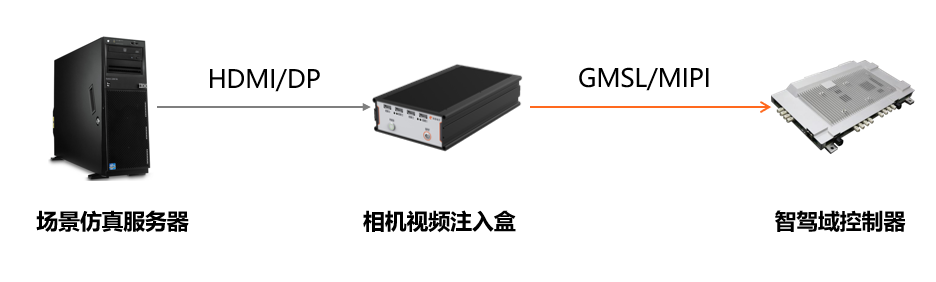
Injecting video data generated by the scene simulation server into the domain control:
Scene simulation video injection:
With the help of professional scene simulation software, various real road conditions such as nighttime strong light and severe weather are simulated, and the generated simulated video data is accurately injected into the domain controller, providing a test environment close to reality for autonomous driving algorithms.
Perception verification addition:
Based on the original planning and control verification, a perception verification link is added. By simulating camera image anomalies, data loss, and other situations, the data processing capability of the domain controller for sensors is comprehensively tested, and its function verification is improved.
DV Automated Testing / EOL Offline Inspection
Generating video data by the video injection box and setting the injection mode:
DV automated testing:
Injecting fixed-mode image data into the system, such as standard test patterns and grayscale images, and cooperating with automated test scripts to achieve all-weather unattended testing, efficiently verifying the stability of the system under different conditions.
EOL offline inspection:
Before the vehicle leaves the factory, specific injection content is set to quickly detect the signal transmission and function operation of the camera module and the domain controller, ensuring that the vehicle's factory quality meets the standards.
Case Sharing
In this case, the basic project requirement is to access scene simulation software and inject 10 channels of virtual camera data in real-time and synchronously into the intelligent driving domain controller to ensure stable reception at the controller end. Through the high-precision video injection of the camera video injection box and rich adaptation experience, engineers quickly built the camera transmission link and met the requirement of synchronous and stable video injection.
On this basis, to verify the safety and stability of the domain control product, the project needs to provide a fault injection function to test the response of the domain control product in abnormal situations. Engineers sequentially carried out fault injections such as frame loss, frame delay, and register simulation faults through the camera video injection box, as follows:
Frame loss fault injection: The normal mipi waveform frame interval is 50ms (20Hz), and optional fault injections include dropping 1 frame every 2 frames (100ms frame interval, 10Hz) and dropping 1 frame every 4 frames (3 data frames every 200ms).
Frame delay fault injection:
Frame delay refers to the interval from the trigger signal to data transmission, which is normally about 50ms. The fault injection can modify it to 20ms.
Injecting camera faults:
By simulating camera temperature faults (including abnormal working conditions such as high temperature and low temperature), after injecting the fault signals into the system, the accuracy of the domain controller's judgment and fault tolerance ability for abnormal environmental conditions can be verified at the underlying software level.
In this case, the camera video injection box helped the customer complete a large amount of verification work in the laboratory, reducing the real-vehicle road test mileage by 30% and identifying potential product risks in advance. It not only reduced the safety risks in the road test process but also effectively saved a lot of time and costs. The customer was able to accelerate the R&D process of the autonomous driving system.
The VCARSYSTEM Camera Video Injection Box effectively solves traditional testing problems with three major technical advantages: millisecond-level multi-channel synchronization accuracy (≤1ms), protocol and hardware adaptation capabilities, and full-scene fault simulation, providing reliable testing support for the R&D to mass production of intelligent driving. In the future, VCARSYSTEM will continue to deepen the intelligent driving testing field, with more efficient and reliable solutions, helping customers accelerate technology implementation, promoting the safety upgrade of autonomous driving, and injecting new momentum into smart travel.