What is the just need of automatic driving development,VCARSYSTEM data reinjection system fills the gap
At present, the speed of change in the automotive industry is extraordinary. With "fast" and "high-level" becoming the key words in the competition of the automatic driving industry, how to improve technology, improve testing efficiency and speed up landing has become an urgent problem to be solved in the industry.
The road test cycle is long, the cost is high, and the scenario conditions covered are limited, especially for the Corner Case, which is difficult to reproduce, and the safety cannot be guaranteed. In contrast, the simulation test scenario configuration is flexible, the scenario coverage is high, and the test process is safe. It can replicate the Corner Case for retesting. Through automated simulation testing, it can significantly reduce costs and increase efficiency.
In recent years, with the rapid development of intelligent driving, the hardware in the loop HIL simulation test technology has begun to show its unique advantages and gradually become a big blue ocean market. In this context, Kunyi Electronics grasped the market opportunity and launched a series of intelligent driving test tools, such as AD HIL and data reinjection system, to provide strong support for building an independent and controllable test chain.
Localization of HIL test chain: a real dilemma in the hot market
Li Kang, the director of technical research and development and founder of Kunyi Electronics, previously disclosed to Gesch Automotive that "according to the prediction of foreign institutions, the global simulation market will reach 10 billion dollars next year."
In the simulation test, hardware in the loop (HIL) simulation occupies a very important position. According to the previous statistics of Huanyang Market Consulting, the global HIL simulation revenue will be about 680.4 million dollars in 2020, and is expected to reach 853.1 million dollars in 2026. From the perspective of products, the HIL simulation market can be divided into systems and services, of which the system accounts for about 85.5% of the market share, with a scale of US $565.06 million in 2020.
At present, HIL simulation technology is widely used in the automotive industry, aerospace, electronic power field. As its largest downstream customer, the market share of the automobile industry will reach 70.8% in 2020.
In the research and development of auto drive system, hardware in the loop testing technology is an important means to study the performance of automobile braking system. The test system can connect the hardware equipment that is difficult to simulate in the actual system or the nonlinear factors that are difficult to express in the pure simulation experiment to the simulation environment through the computer to test the vehicle braking performance. The HIL test is used to study the vehicle braking performance, which can shorten the product development cycle and reduce the development cost while ensuring the safety of personnel.
Although HIL simulation testing has only begun to enter the public view in China in recent years, the global market competition in this field has already started.
Dspace, National Instruments, Vector Informatik, ETAS and other manufacturers from developed countries in Europe and the United States, led by the United States, have taken the lead in the global hardware environment simulation market by virtue of their first mover advantage and mature simulation products.
However, compared with Europe and the United States, China's hardware in the loop simulation test industry started late and is still in the early stage of development. Moreover, due to the relatively complex road environment and traffic composition in China, and diversified driving behaviors, autonomous vehicle face challenges in correctly identifying the environment and making accurate responses. It is more difficult to build a road scene database for China's complex road conditions, which shows that the development path of simulation testing in China is not smooth.
However, as Li Kang said, "the core of our industrial chain cannot always rely on foreign countries". In today's uncertain environment, domestic substitution may become the fundamental evolution logic of China's auto parts industry in the future.
In the face of pre emptive "big factories", how can domestic manufacturers win in the fierce competition?
Technological innovation may be a way out. In this context, Kunyi Electronics, a local automotive electronic tool chain supplier in China, takes the advantages of high-precision synchronization, customizable solutions, high integration, independent research and development as its core competitiveness, and its AD HIL, data reinjection system and a series of intelligent driving test tools have been widely used.
HIL test: accelerator for autopilot development
Hardware in the loop testing is an important part of the V model development process. Hardware In the Loop (HIL for short). The "in the loop" emphasizes that the controller under test must be in a closed loop.
In short, its principle is to use HIL equipment to receive control instructions, simulate state information and send it back to the controller, so that the controller thinks it is controlling the real test object, forming a test loop. In this way, the logic of the functional algorithm can be directly verified in the test loop.
In addition, in the face of automatic driving, the controller needs to be able to properly handle failures, such as signal loss, short circuit, etc. These faults are difficult to set and reproduce on the real vehicle, and they are dangerous. Through HIL test, multiple faults can be easily selected, combined and tested, which can not only improve the test efficiency, but also reduce the safety risk of real vehicle road test.
Therefore, hardware in the loop is usually used for system integration testing to verify the functional effectiveness of important modules such as automatic driving vehicle environment awareness.
Taking the HIL system of Kunyi Electronics as an example, the HIL test system is usually composed of real-time simulation hardware system, real-time model, management software and external equipment. The data flow of Zhijia Road Collection HIL scheme is as follows:
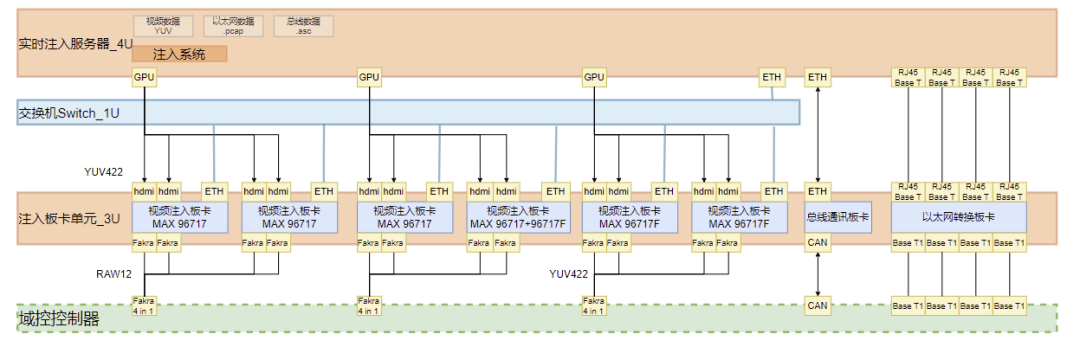
Photo source: VCARSYSTEM
As shown in the figure, to form a test loop, data injection is an essential key link.
What kind of data reinjection scheme is required for advanced automatic driving?
HIL testing is a typical demand scenario for intelligent drive reinjection equipment. As an important part of the closed loop test flow of high order autopilot, the autopilot data reinjection system undertakes the important task of the performance and function of the test domain controller.
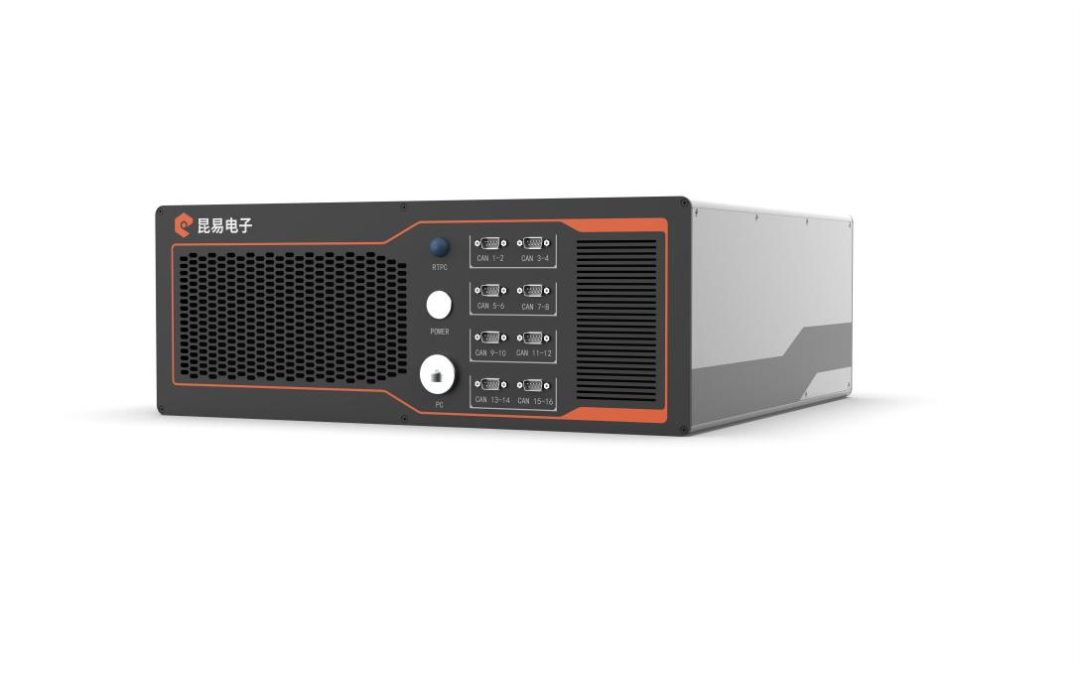
VCARSYSTEM Data Reinjection Equipment Source: VCARSYSTEM
This means that the data injection scheme needs to solve the problem of data source during controller testing, and inject highly restored sensor data into the domain controller. This scheme not only needs to support the scene data reinjection of data acquisition to realize the fast reproduction of Corner Case, but also needs to support large-scale automatic regression testing. In addition, virtual sensor content injection generated by scene simulation software is also needed to expand the richness of controller test scenarios.
Specifically, in automatic driving, there are often long tail scenes such as traffic accidents, traffic jams, animals scurrying on the road, traffic lights behind trucks, and backlight generated by snow and sunlight. The reappearance of these Corner Cases has been a major pain point in automatic driving simulation testing for a long time.
In this regard, Kunyi Smart Drive Reinjection Equipment can enable these Corner Case materials to form data prototypes, simulate simulation scenarios and inject them into the domain controller, and the domain controller can use the above data to form the output of open-loop sensing results to realize the scene reproduction.
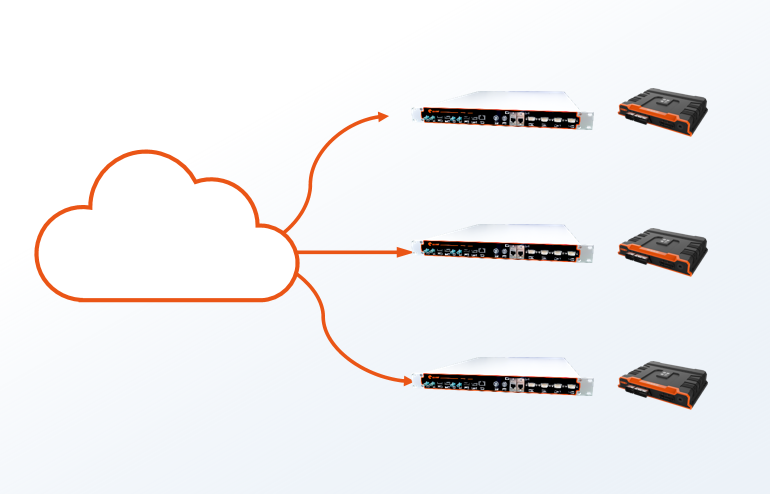
Photo source: VCARSYSTEM
In addition, today's OTA makes regression test verification necessary in the life cycle of the vehicle. As time accumulates, the amount of scene set data to be verified becomes larger and larger. A single HIL verification will not meet the timeliness requirements. How to meet the time and efficiency requirements of simulation closed-loop testing becomes a problem.
In view of the above pain points, Kunyi Smart Drive Reinjection Equipment can automatically test and output reports based on automated scripts, and synchronize and verify data based on private clusters to achieve clustered regression testing. At the same time, Kunyi reinjection equipment integrates a large number of bus, video and Ethernet interfaces, supports multi board synchronization, and can trigger the response by the domain controller to form a test loop efficiently and quickly.
What are the advantages of the HIL plan of Kunyizhi Road Mining?
The data reinjection system is prone to various adaptation problems in HIL testing, such as the controller has adaptation requirements for different serial deserializers, too large video data bandwidth leads to system performance bottlenecks, and the controller needs to access a large number of camera channels.
In this regard, Kunyi, with its rich experience in interfacing various serializers and deserializers, can quickly adapt the handshake protocol and the video data transmission mode of the simulation camera module. In the face of large bandwidth video data, Kunyi's solution is to try to complete the calculation and image processing in the GPU and directly output to the HDMI interface in the process of video data processing, so as to reduce the system performance burden caused by large amount of data moving back and forth.
In addition, as for the requirements of customized data formats, the intelligent drive reinjection system of Kunyi supports the analysis of user-defined video, bus and Ethernet data formats, and can quickly adapt to the reinjection system. For example, it supports the transmission of simulation data signals in the publish and subscribe mode through DDS middleware.
In order to cope with the large number of camera channels that the controller needs to access, the VCARSYSTEM Smart Drive Reinjection System can quickly stack expansion boards, and achieve high-precision time source synchronization between boards through PTP. It also supports the IO trigger signal sent by the controller, ensures the synchronous transmission of high-quality video data to the controller, and speeds up the development and verification process of the controller algorithm.
VCARSYSTEM has a wealth of self-developed boards and cards. In the face of multiple types of hardware interfaces, it can perform video conversion, bus data injection, and on-board Ethernet data injection, and can flexibly configure the number and type of board and card interfaces according to customer needs.
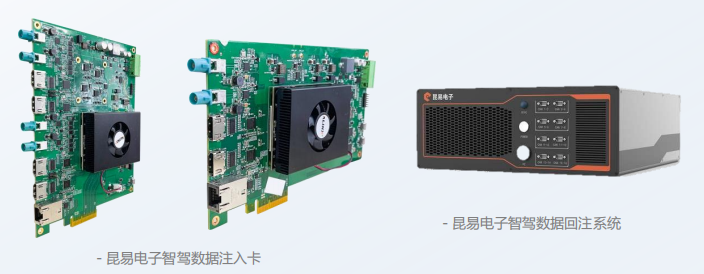
Photo source: VCARSYSTEM
When it comes to Kunyi's self-developed board, we have to mention another technical advantage of Kunyi's intelligent drive reinjection system - video injection board. Large bandwidth video injection also brings high performance video injection board requirements for data reinjection system.
The working mode of video injection board developed by Kunyi includes simulation injection and road recovery reinjection, which supports various resolutions, up to 800W pixels 30fps, video frame fault simulation and I2C fault simulation. This board can convert HDMI signals to MIPI/DVP signals. It is worth mentioning that this board can also pack MIPI signals according to the controller requirements, and add the required additional information. In the face of the need for multiple boards, multiple cards can send data synchronously.
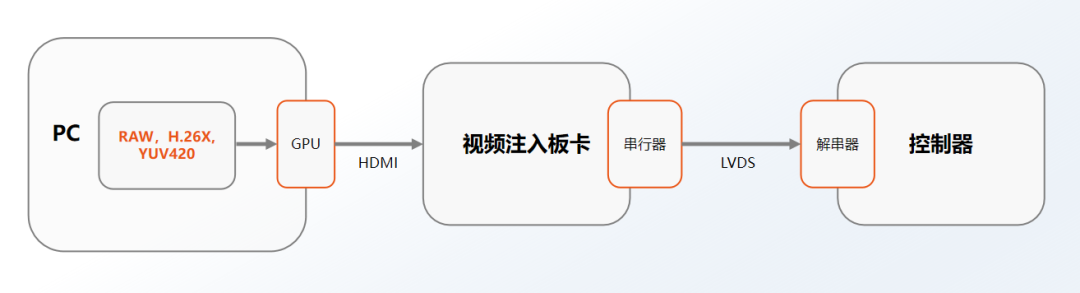
Photo source: VCARSYSTEM
In a word, VCARSYSTEM Intelligent Drive Reinjection Equipment can efficiently complete the open-loop test and regression test of the controller through video injection, bus injection, vehicle Ethernet injection and other methods by combining the reinjection software and scene simulation software.
Calmly Cope with R&D and Testing Challenges Kunyi's Full Stack Ability Helps Industrial Development
VCARSYSTEM, founded in 2011, is engaged in embedded software and hardware development and testing, bus development and testing equipment development, production and sales, serving automotive, rail transit, power and other markets, and assisting global enterprises in research and development. Since its establishment, Kunyi Electronics has been committed to independent research and development of core technologies, building research and development tool chains and building an ecosystem for product development.
In recent years, Kunyi Electronics has focused on the field of automatic driving. It has developed a series of high-performance tools and customized solutions in terms of self driving data acquisition, image processing algorithms, data injection, virtual simulation testing, etc., to cope with the changes and challenges brought about by automotive electrical intelligence. It has become a tool supplier for many domestic front-line self driving enterprises. At present, its data reinjection system has served the road production reinjection of car manufacturers such as Weilai, Lutes and Baidu, and the simulation closed-loop injection of Tier1 such as Desai Xiwei.
Taking the AD HIL scheme provided by Kunyi for Desai Xiwei as an example, the primary feature of this scheme is to simulate closed-loop injection. In addition, it can realize forward looking camera video+forward millimeter wave radar injection, scene design and construction, and provide real-time system vehicle dynamics model prototype.
In the project cooperation with customers, Kunyi has also demonstrated a series of corresponding technical capabilities through road mining reinjection cluster test system, simulation open-loop injection test, vehicle VIL hub laboratory closed-loop test and other projects. Among them, in the simulation open-loop injection test project, the injection board card unit provided by Kunyi has effectively assisted customers to complete the open-loop verification of domain controller HIL simulation through scene simulation, open-loop injection and I2C fault simulation, which also reflects the concept of Kunyi Electronics - "making research and development easier".
Next, VCARSYSTEM will continue to make efforts in the field of automatic driving. Specifically, in terms of intelligent driving data reinjection products, Kunyi will continue to create more injection products and adapt them to different sensors, thus realizing HIL's adaptation to different controllers or different experimental systems. In addition, we will make synchronous efforts in data acquisition and other products, and finally get through each link of the test chain.
In recent years, the voice of "domestic substitution" has gradually risen, and chip led components have become the focus of localization of the supply chain.
However, in fact, every link in the industrial chain under the current trend of domestic substitution cannot be ignored. As the core link of the industrial chain, the tool chain is crucial for building a resilient and competitive automated driving industrial chain. As Kunyi Electronics firmly believes, the independent and controllable automotive electronics R&D tool chain is a just need for the development of the automotive industry and will certainly become the mainstream.
It can be predicted that in the future intelligent electric vehicle era, the Chinese local test tool chain manufacturers represented by VCARSYSTEM will have a place.